


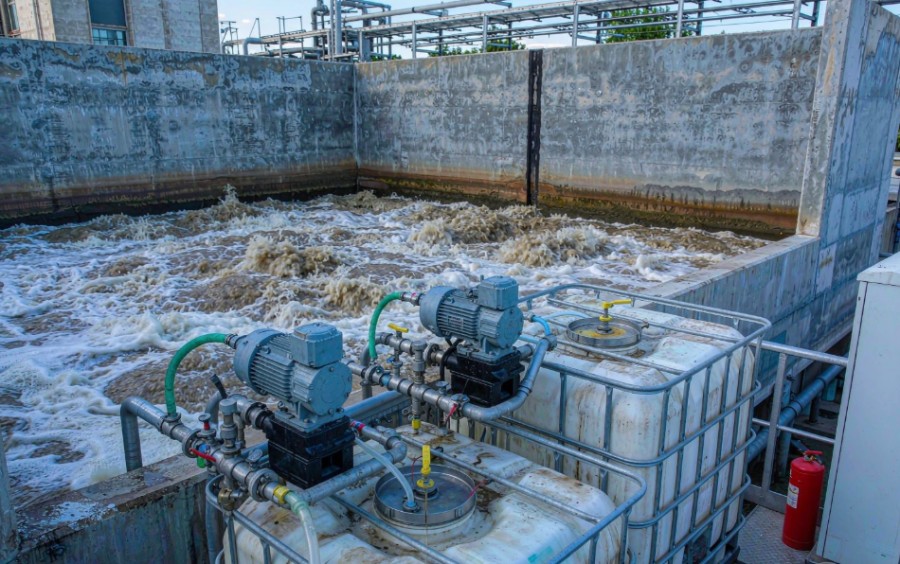
Carbon source dosing skid beside an aeration tank at a municipal wastewater plant.
Heterotrophic denitrifying bacteria need an available electron donor to convert nitrate (NO₃⁻-N) into nitrogen gas. When the influent carbon-to-nitrogen ratio is too low — common after high-strength anaerobic treatment, in low-COD municipal streams, or with high nitrate recycles — denitrification simply runs out of food. Total nitrogen rises, and the discharge permit becomes a commercial risk. The standard fix is dosing an external carbon source into the anoxic zone.
Carbon sources are usually compared by price per ton, which is misleading. The numbers that actually determine cost per kilogram of nitrogen removed are:
| Criterion | NBC+ composite carbon source | 60% sodium acetate | Methanol | Glucose |
| COD equivalent | 200,000–1,000,000 mg/L (five grades: NBC-20W/30W/50W/70W/1M) | ~440,000 mg/L | High (pure, but hazardous) | Moderate |
| Actual consumption (g/g NO₃-N) | ~4.0* | ~8.5 | ~4.5–5.5 (site-dependent) | High |
| Sludge yield (gVSS/gCOD) | 0.20–0.30 | ~0.3 | ~0.3 | up to 0.6 (sucrose-type) |
| Freezing point | down to ≤ −30°C (grade-dependent) | +13°C (solution — needs winter insulation) | Very low, but flammable | Solution-dependent |
| Safety / handling | Non-hazardous, non-biotoxic | Non-hazardous | Flammable & toxic — special storage | Non-hazardous |
* Manufacturer comparison data from GZXZEP technical documentation; verify with a site trial on your own return liquor.
Every kilogram of COD dosed becomes either nitrogen gas or new biomass. High-yield carbon sources (sugar-based products can approach 0.6 gVSS/gCOD) convert a chemical purchase into a sludge-disposal bill. In GZXZEP’s comparative data, switching to NBC+ reduced observed sludge production by about 30% versus conventional sources, with overall running cost reductions of 20–40% once dosing, sludge and winter handling are included.*
Response speed matters for plants with load swings: small-molecule sources respond within hours, which is why sodium acetate remains popular for emergencies. NBC+ combines fast-start compounds with slow-release fractions so that residual dosing keeps working between dose events.
A good carbon source badly dosed wastes money in both directions. The NBC+ dosing package pairs variable-frequency metering pumps with online NO₃-N and COD monitoring, so the dose tracks the actual nitrate load — no more fixed “refrigerator-magnet” dosing rates. Plants run unattended with overdosing alarms and consumption logs per shift.
Municipal trust in this combination is growing: GZXZEP recently won an annual NBC+ supply contract with a large Huizhou water utility (see company news). If you are evaluating carbon sources, our R&D Center offers a denitrification-rate screen on your actual return liquor — request the bench protocol.