

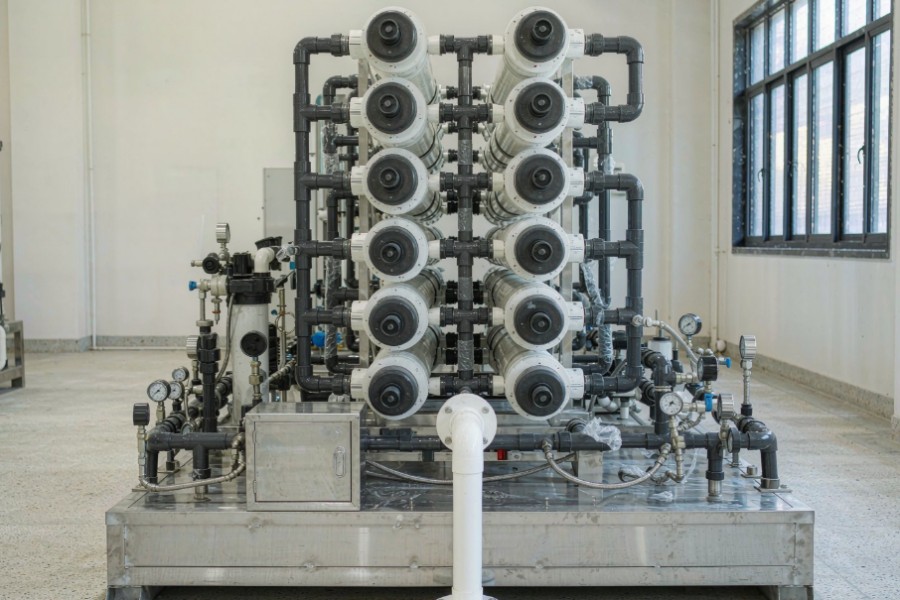
Spiral-wound RO membrane elements on a dosing-equipped treatment skid.
Every reverse-osmosis membrane problem belongs to one of four families, and each demands different chemistry:
Misdiagnosis is expensive: acid-cleaning a biofouled membrane achieves little, while alkaline-cleaning a scaled membrane can worsen it.
Dose antiscalant into the raw feed upstream of the cartridge filter so it disperses fully before the elements. GZXZEP’s XZ99xx program offers two grades: XZ9901 (acid-type, pH 2.5±0.5, specific gravity 1.1±0.05) at 3–10 ppm, and XZ9902 (alkaline-type, pH 10.0±1.0, specific gravity 1.15±0.03) at 3–8 ppm — selected by feed chemistry and LSI/S&DSI projection.
Where SDI is driven by colloids, XZ9904 flocculant at 1–5 ppm continuous dosing ahead of multimedia filtration keeps SDI₁₅ below 3–4, protecting the elements far more cheaply than premature CIPs.
Chlorine destroys polyamide membranes; control biofouling instead with a compatible non-oxidizing biocide such as XZ9903: continuous dosing at 1–5 ppm, intermittent dosing at 100–500 ppm for the affected train, or a shock soak at 1% solution for ~60 minutes during standby.
Rule of thumb: every 1°C of unexpected feed-temperature rise and every 0.1 of LSI you allow through shifts you closer to a mid-year CIP. Antiscalant costs cents per m³; a membrane element replacement costs hundreds of dollars.
When normalized performance tells you cleaning is due, resist the temptation to dump everything in one tank. The GZXZEP standard sequence:
| Step | Action | Chemistry | Purpose |
| 1 | Prepare cleaning solution | 2–4% dilution (product-specific) | Correct strength, temperature and pH |
| 2 | Acid clean, low circulation | XZ9905 acid cleaner (2% solution pH ~3.0) | Dissolve CaCO₃, iron and metal oxides |
| 3 | Rinse to near-neutral | RO permeate | Prevent acid–alkali reaction in elements |
| 4 | Alkaline clean | XZ9906 alkaline cleaner (2% solution pH ~11.0) | Remove organics, colloids and biofilm residues |
| 5 | Flush & return to service | Permeate flush | Verify normalized flux recovery > 90% |
For biofouled trains, insert a biocide soak (XZ9903, ~1%, 60 min) between the acid and alkaline stages — the acid stage opens the biofilm matrix so the biocide reaches the organisms, and the alkaline stage then flushes the debris.
Trigger a CIP when any of these appear in normalized data (not raw readings): normalized permeate flow down ~10%, normalized pressure drop up ~15%, or a sustained rise in salt passage. Cleaning too late lets foulants compact into a layer no chemistry can fully remove; cleaning too early wastes downtime. Log feed, interstage and concentrate data daily so the trend is visible.
Always verify cleaning chemistry against your membrane manufacturer’s pH and temperature limits, and never mix acid and alkaline concentrates in one tank. GZXZEP’s R&D Center runs compatibility and cleaning-recovery screens on used elements — send us your feed analysis and we will assemble the XZ99xx grades, dosing points and CIP protocol for your train.