

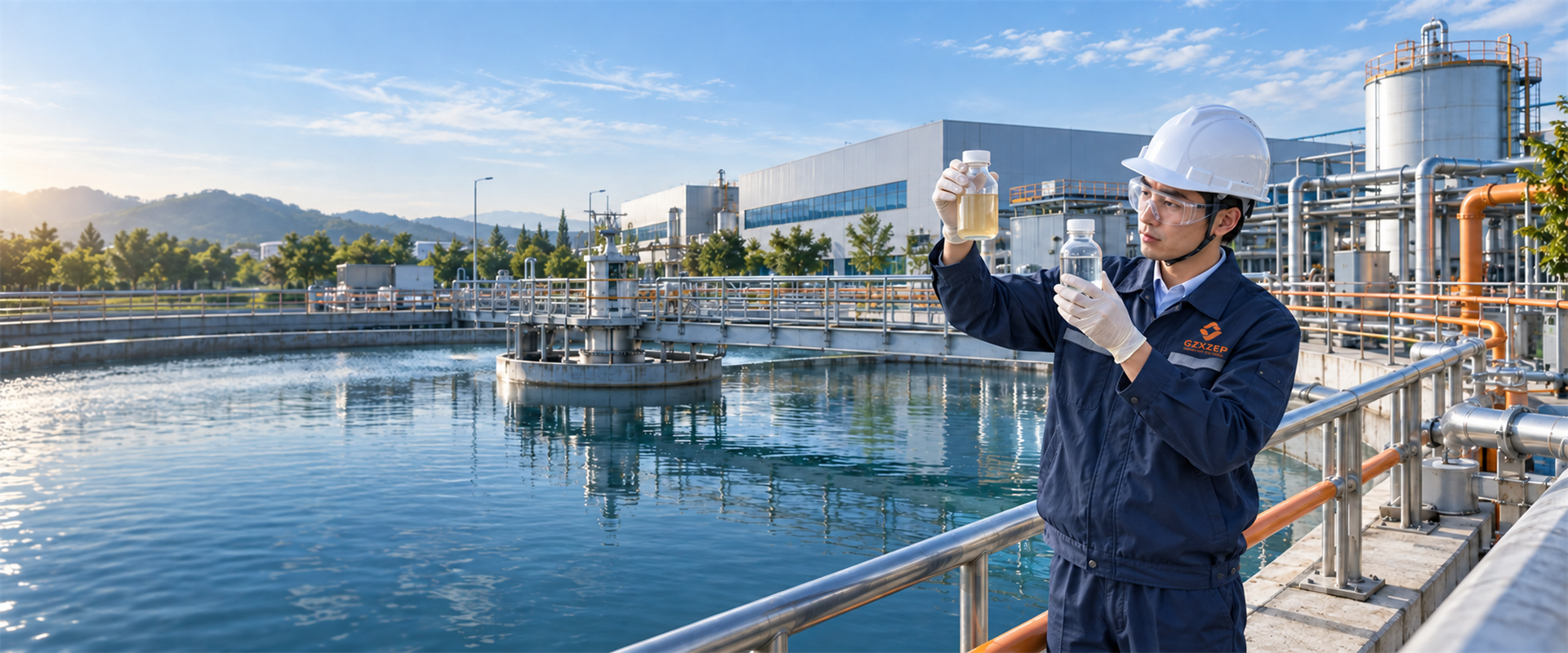
Products for variable COD, foam, salinity, nitrogen removal, concentration and water reuse.
Textile dyeing wastewater changes with fiber, dye, auxiliary chemical and production schedule. Color, surfactants, salinity, refractory organics, foam and nitrogen loading can stress both physicochemical and biological treatment.
GZXZEP supplies selected products for biological enhancement, foam control, denitrification, evaporation and RO reuse. The current website list does not include a dedicated decolorizer, so color-removal claims are not made on this page.
| Treatment challenge | Treatment approach | Relevant GZXZEP products | Application point |
| High and variable COD | Evaluate general or aromatic-compound cultures after pretreatment. | XZ8811; XZ8831 | Biological treatment |
| High salinity inhibits biomass | Use gradual acclimation and evaluate a salt-tolerant culture. | XZ8871 Halotolerant Culture | Biological tank |
| Persistent surfactant foam | Select dose through foam testing. | XZ8605 General Wastewater Defoamer | Foaming zone |
| Low-C/N nitrate removal | Add external carbon where mass balance shows a deficit. | NBC-70W or NBC-44WS; XZ8822 | Anoxic tank |
| Concentrate or RO problems | Use process-specific MVR or membrane chemicals. | XZ-0188; XZ9901/XZ9902/XZ9903/XZ9905/XZ9906 | MVR and RO systems |
XZ8811 supports general COD degradation, while XZ8831 is intended for persistent aromatic compounds. XZ8871 may be evaluated where salinity limits biological activity after gradual acclimation. Trials should track COD, toxicity and sludge behavior.
Link: Explore Microbial Treatment Products
XZ8605 is intended for wastewater foam. For nitrate removal, NBC-70W or NBC-44WS supplies external carbon and XZ8822 may be evaluated for denitrification. Carbon dosing should be controlled to avoid residual COD.
Link: Explore Wastewater Treatment Chemicals
Link: Explore External Carbon Sources for Denitrification
XZ-0188 is intended for MVR foam. RO antiscalants, biocide and cleaners should be selected using feedwater analysis and membrane limits after adequate color, solids and organics pretreatment.
Link: Explore RO Membrane Treatment Chemicals
GZXZEP provides product selection, laboratory evaluation and application support. Final performance depends on wastewater characteristics, process conditions, equipment and site operation.
A dedicated decolorizer is not included in the current website product workbook. This page therefore focuses on the listed biological, foam, nitrogen and membrane products.
XZ8871 may be evaluated after gradual acclimation. Salinity, temperature and pollutant toxicity must be included in the trial.
Yes, where biodegradable carbon limits denitrification. Dose must be based on nitrate loading and monitored to prevent excess residual COD.
Provide the wastewater source, flow, recent analysis, current treatment process, chemicals now in use and the required discharge or reuse target. A sample may be requested after the initial review.
Share the production process, wastewater analysis, salinity, current treatment train and discharge or reuse target.