

NBC+ composite carbon source supply and dosing support for a municipal water utility.
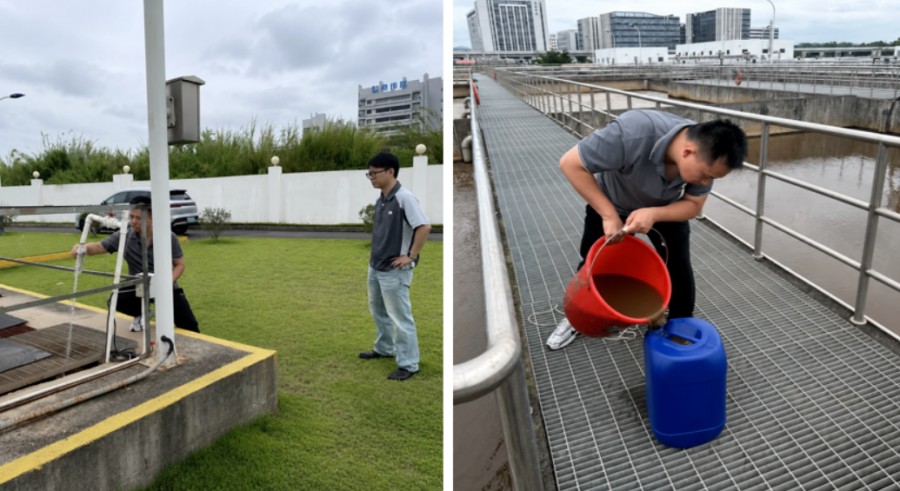
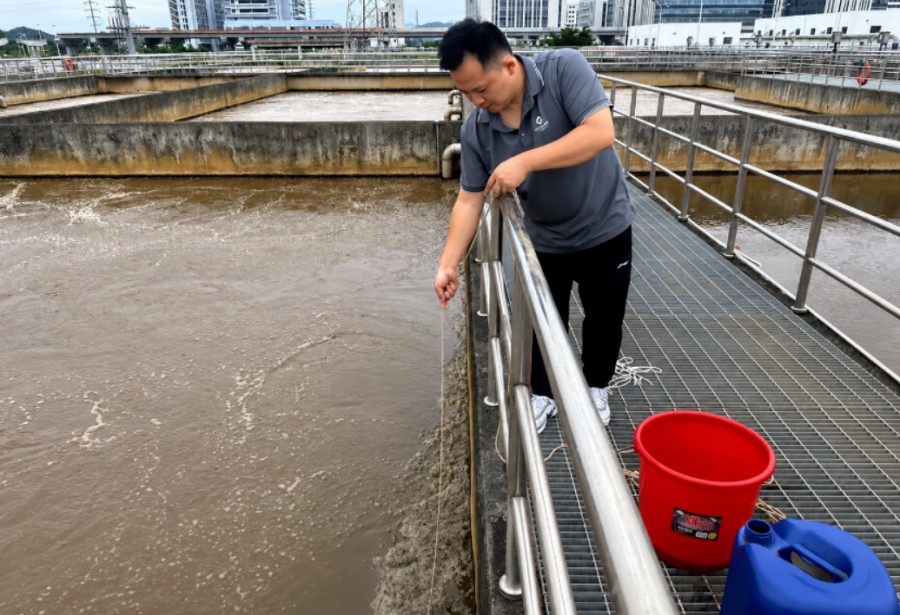
Guangzhou, China — GZXZEP has successfully won the annual supply tender for composite carbon source with a large water utility in Huizhou, Guangdong Province. The contract covers year-round NBC+ composite carbon source supply with batch COA documentation and technical dosing support for the utility’s biological nutrient removal process.
Why municipal utilities choose NBC+
Municipal tenders for external carbon sources are decided on more than unit price. The evaluation typically weighs:
Consumption efficiency — NBC+ requires roughly half the dosing rate of 60% sodium acetate per kilogram of nitrate nitrogen removed in GZXZEP comparison data (approx. 4.0 vs 8.5 g/g NO₃-N).*
Sludge handling — lower biomass yield (0.20–0.30 gVSS/gCOD) means less dewatering and disposal cost for the utility.
Winter logistics — grade-dependent freezing points down to ≤−30°C eliminate the winter insulation and heating that acetate solutions (freezing around +13°C) demand.
Safety profile — non-hazardous, non-biotoxic classification simplifies storage and transport permits.
Supply stability — four production bases (Guangzhou, Chengdu, Zaozhuang, Jiuquan) with 30,000 t/a capacity and batch COA on every lot.
* Manufacturer comparison data; verify on your own return liquor through a bench test.
What the contract includes
Beyond product supply, the agreement covers seasonal grade adjustments (winter vs summer COD-equivalent grades), dosing-system health checks by GZXZEP engineers, and periodic review of consumption per unit of nitrogen removed — the number that ultimately decides the utility’s real cost.
Supply for export customers
The same NBC+ grade system (NBC-20W/30W/50W/70W/1M, COD equivalents from 200,000 to 1,000,000 mg/L) is available to international customers, with export documentation, SDS and flexible packing. Our R&D Center provides denitrification-rate screening on customer return liquor before orders — request the bench protocol and a sample.
Related reading: Choosing an external carbon source for denitrification.