

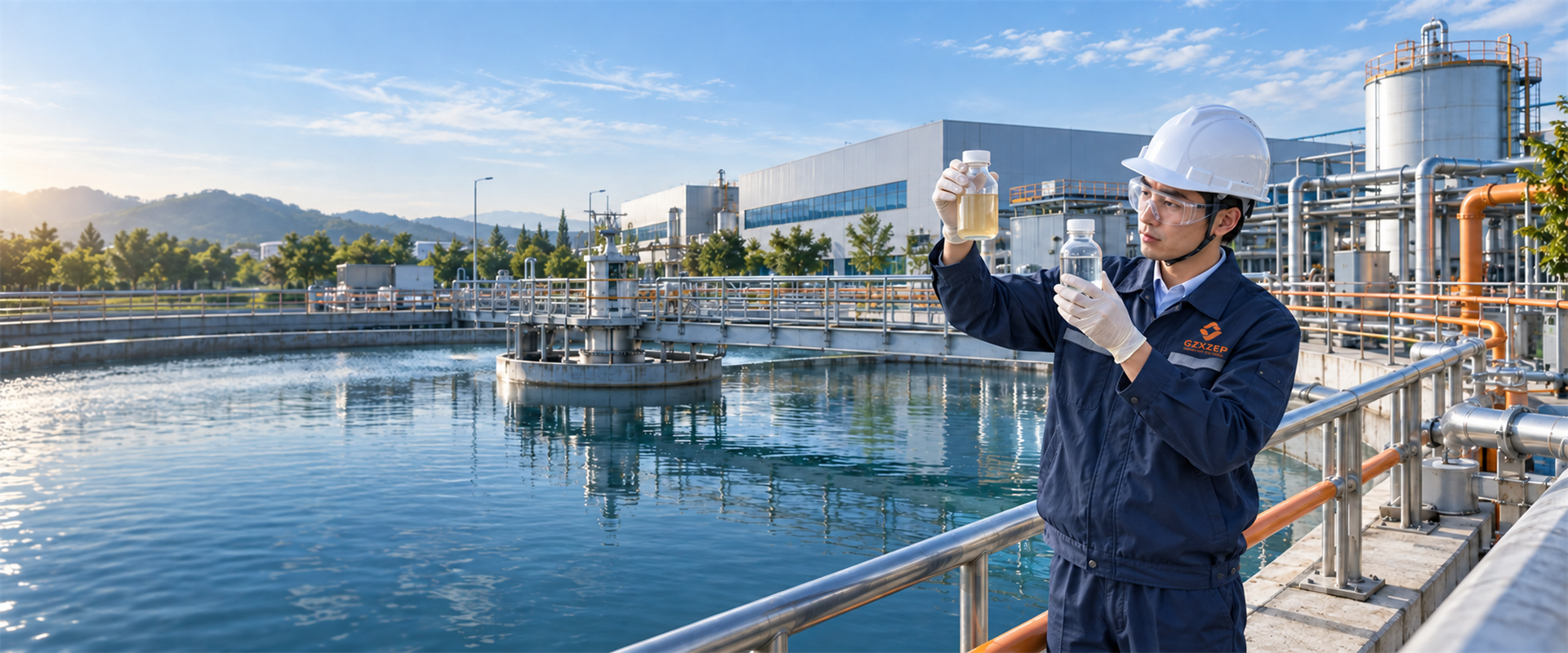
Products for organic load, biological stability, foam, nitrogen control, odors and water reuse.
Food and beverage wastewater often contains sugars, starch, proteins, fats and cleaning chemicals. Seasonal production and cleaning cycles can create sharp changes in COD, foam, pH and nutrient balance.
GZXZEP products support biological treatment, foam control, denitrification, collected-air odor treatment and RO reuse after appropriate solids and fat removal.
| Treatment challenge | Treatment approach | Relevant GZXZEP products | Application point |
| High biodegradable COD and load shocks | Equalize the flow and evaluate COD-degrading bioaugmentation. | XZ8811; XZ8801 where municipal-type recovery is relevant | Biological treatment |
| Persistent foam | Select a defoamer by foam test. | XZ8605 | Foaming zone |
| Low-C/N nitrate removal | Add external carbon where required. | NBC-70W or NBC-44WS; XZ8822 | Anoxic tank |
| Odors from wastewater and sludge | Use an approved misting or wet scrubber system. | Plant-Based Odor Control Products | Spray or recirculation system |
| RO reuse scaling and biofouling | Select antiscalant, biocide and cleaners from feedwater data. | XZ9901/XZ9902/XZ9903/XZ9905/XZ9906 | RO feed and CIP |
Solids, fats and extreme pH should be controlled before biological treatment. XZ8811 may be evaluated for residual COD and recovery after organic load shocks.
Link: Explore Microbial Treatment Products
XZ8605 supports foam control. Where anoxic denitrification lacks carbon, NBC-70W or NBC-44WS may be evaluated together with XZ8822 where bioaugmentation is appropriate.
Link: Explore Wastewater Treatment Chemicals
Link: Explore External Carbon Sources for Denitrification
Plant-based odor products may be used in compatible wet-contact systems. RO chemicals support scale, microbial and CIP control after upstream removal of fats, solids and organics.
Link: Explore Plant-Based Odor Control Products
Link: Explore RO Membrane Treatment Chemicals
GZXZEP provides product selection, laboratory evaluation and application support. Final performance depends on wastewater characteristics, process conditions, equipment and site operation.
No. Fats and suspended solids should be controlled upstream to protect biological treatment.
XZ8605 is the listed general wastewater treatment defoamer. Confirm dosage by foam testing.
RO may be part of a reuse train, but feedwater quality, pretreatment, scale risk and membrane compatibility must be reviewed.
Provide the wastewater source, flow, recent analysis, current treatment process, chemicals now in use and the required discharge or reuse target. A sample may be requested after the initial review.
Share the product type, production cycle, wastewater analysis, pretreatment and reuse target.