

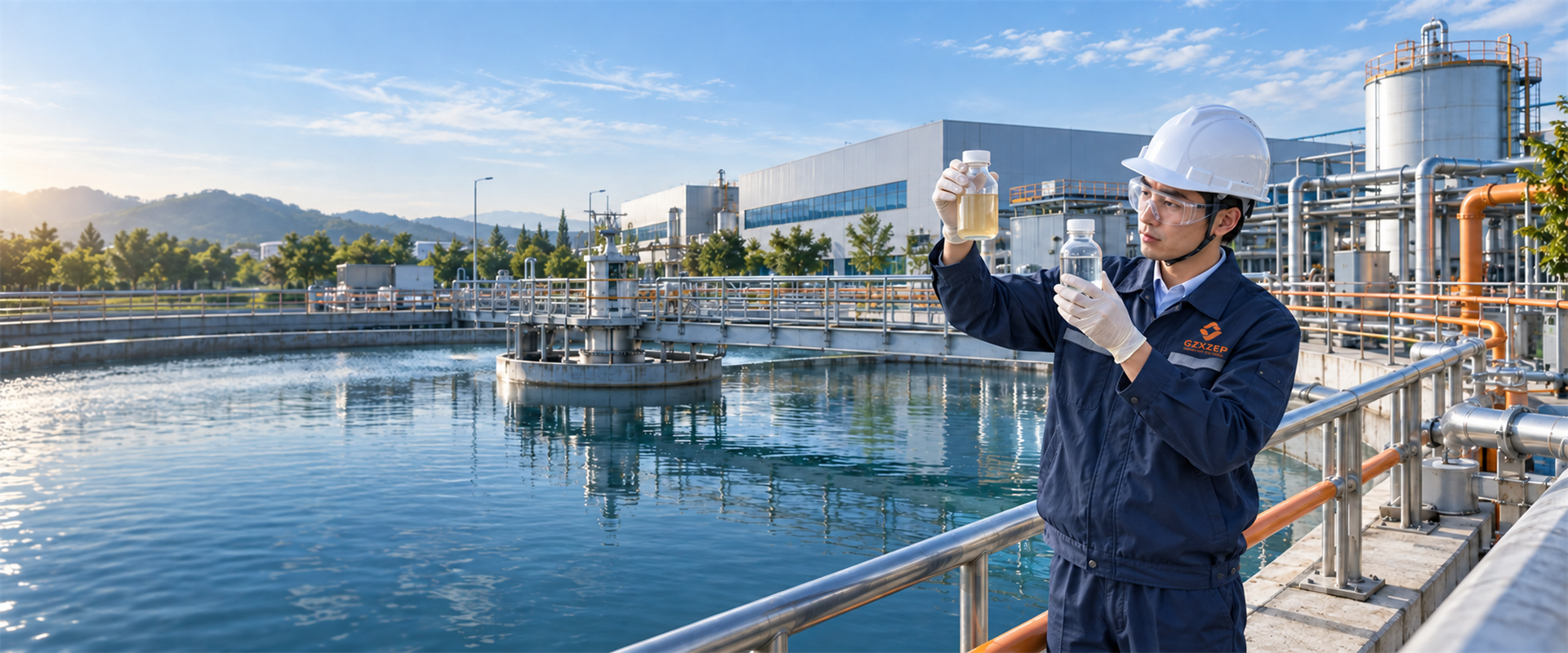
Products for emulsified wastewater, refractory organics, nitrogen removal, process foam, odors and RO reuse.
Chemical manufacturing wastewater can change sharply with raw materials, batches and cleaning cycles. Stable emulsions, high or refractory COD, ammonia, salinity, foam and odorous exhaust air may occur in the same facility, while each problem requires a different treatment approach.
GZXZEP manufactures wastewater chemicals, microbial products, external carbon sources, plant-based odor control products and RO membrane chemicals. We help chemical manufacturers, engineering companies and distributors select products according to wastewater composition, the existing treatment process and the required treatment target.
| Treatment challenge | Treatment approach | Relevant GZXZEP products | Application point |
| Stable oily emulsions and poor oil-water separation | Use bench jar testing to screen an emulsion breaker before flotation, settling or downstream biological treatment. | OWT Series Emulsion Breaker | Equalization or physicochemical pretreatment stage |
| High or refractory COD | Evaluate biological enhancement according to the dominant organic compounds and possible inhibition. | XZ8811 COD-Degrading Microbial Consortium; XZ8831 Aromatic-Ring Degradation Microbial Consortium; XZ8851 Hydrocarbon-Degrading Microbial Consortium | Hydrolysis-acidification, aerobic or biological treatment stage |
| Ammonia or total nitrogen instability | Review nitrification and anoxic denitrification separately; add carbon where biodegradable carbon is insufficient. | XZ8821 Nitrifying Microbial Consortium; XZ8822 Denitrifying Microbial Consortium; NBC-70W or NBC-44WS carbon source | Aerobic nitrification stage and anoxic tank |
| High salinity or biological shock | Use acclimated cultures or a biostimulant where site evaluation supports bioaugmentation. | XZ8871 Halotolerant Microbial Consortium; XZ8809 Biostimulant | Biological treatment stage |
| Process foam or evaporator foam | Select the defoamer for the actual liquid, temperature and downstream process. | XZ8605 General Wastewater Treatment Defoamer; XZ-0188 MVR Evaporator Defoamer | Foaming tank or MVR feed/circulation system |
| Odorous collected exhaust air | Polish suitable collected exhaust through a compatible wet scrubber or spray tower. | NPD3010 Plant-Based Deodorizer for Industrial Exhaust | Wet scrubber or spray-tower recirculation water |
Cutting fluids, process oils, surfactants and cleaning agents can form stable oil-in-water emulsions that resist gravity separation. High residual oil and COD can overload flotation units and inhibit downstream biological treatment.
The OWT Series Emulsion Breaker destabilizes emulsified droplets and supports subsequent floc formation and oil-water separation. Sixteen grades are listed in the product file, so grade selection should be confirmed by jar testing on the actual wastewater. The test should compare separation speed, supernatant clarity, sludge production and the effect on downstream treatment.
Link: Explore Wastewater Treatment Chemicals
Chemical wastewater may contain readily biodegradable compounds together with persistent aromatic or hydrocarbon pollutants. A single general culture is therefore not appropriate for every stream.
XZ8811 supports COD degradation in difficult industrial wastewater. XZ8831 is intended for wastewater containing persistent aromatic compounds, while XZ8851 is intended for petroleum-hydrocarbon contamination after suitable oil separation or flotation. Product selection should follow wastewater characterization and a controlled biological trial.
Link: Explore Microbial Treatment Products
High ammonia and total nitrogen require separate checks of the aerobic nitrification stage and the anoxic denitrification stage. XZ8821 supports nitrification, and XZ8822 supports denitrification where bioaugmentation is appropriate.
When low biodegradable carbon limits nitrate removal, NBC-70W liquid composite carbon source or NBC-44WS solid sodium acetate can supply an external electron donor. The dose should be based on nitrogen loading, available influent carbon and operating data, with residual COD monitored during optimization.
For saline wastewater, XZ8871 can be evaluated after gradual acclimation. XZ8809 may support microbial recovery after start-up or process shock, but the source of toxicity or inhibition should also be corrected.
Link: Explore External Carbon Sources for Denitrification
Link: Explore Microbial Treatment Products
XZ8605 is designed for foam in biological and physicochemical wastewater systems. XZ-0188 is intended for MVR evaporators and high-temperature wastewater concentration. Testing should confirm dosage, persistence and compatibility with downstream membranes or biological treatment.
NPD3010 is intended for industrial exhaust odor control through compatible wet scrubbers and spray towers. It is an odor-polishing product and does not replace the primary control of particulates, corrosive gases or hazardous air pollutants.
For RO reuse, XZ9901 and XZ9902 antiscalants, XZ9903 non-oxidizing biocide, and XZ9905/XZ9906 membrane cleaners may be evaluated according to feedwater analysis, foulant type and membrane-manufacturer limits.
Link: Explore Plant-Based Odor Control Products
Link: Explore RO Membrane Treatment Chemicals
GZXZEP provides product selection, laboratory evaluation and application support. Final performance depends on wastewater characteristics, process conditions, equipment and site operation.
Start with the OWT Series Emulsion Breaker when stable emulsions prevent oil-water separation. The correct grade must be selected by jar testing because wastewater chemistry and emulsifiers vary by process.
No. Product selection depends on the dominant pollutants and possible toxicity. XZ8811 is a broad COD-degrading culture, while XZ8831 and XZ8851 target aromatic compounds and hydrocarbons respectively.
External carbon mainly supports anoxic denitrification after ammonia has been oxidized to nitrate or nitrite. High ammonia requires review of the aerobic nitrification conditions and may justify evaluation of XZ8821.
XZ-0188 is the listed MVR evaporator defoamer. XZ8605 is intended for general wastewater treatment. Final selection and dosage should be confirmed under the actual temperature, salinity and circulation conditions.
Provide the wastewater source, recent analysis, flow, pH, temperature, salinity where relevant, existing process, current chemicals and treatment target. A sample may be requested after the initial technical review.
Share your wastewater composition, treatment process and current operating problem. Our team will identify relevant products and the next evaluation step.